
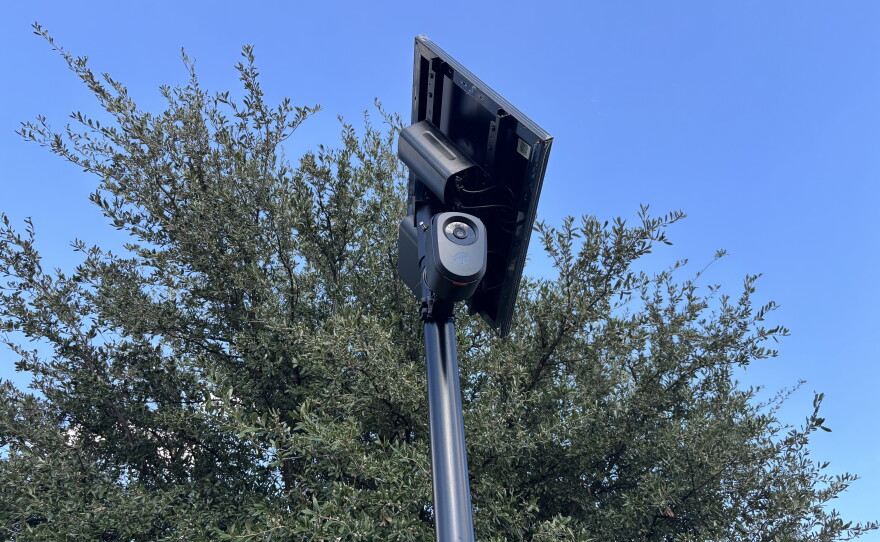
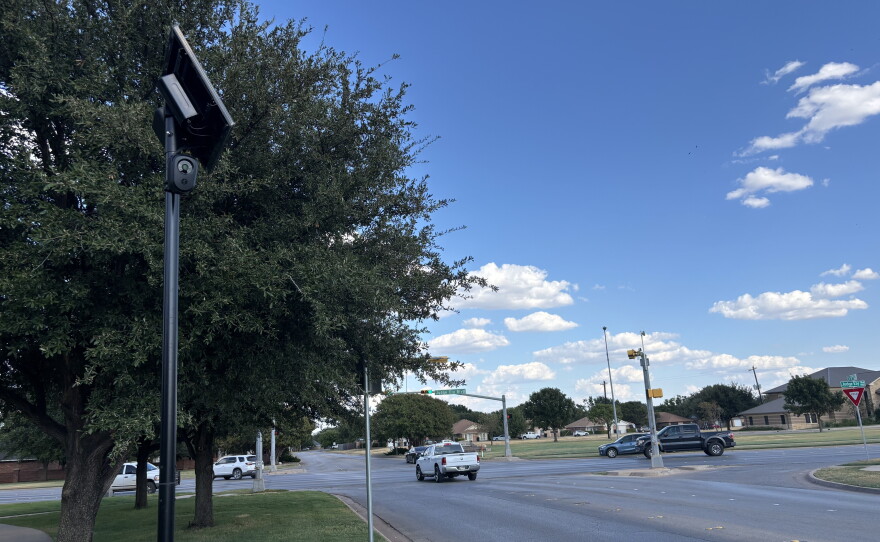
Automated license plate readers are now operating at four intersections around Abilene Christian University, giving campus police a new tool for investigations and security. As the technology has sparked criticism in many communities, officials are prepared to answer questions about how the technology is used and who can access the data.
The cameras were installed over the summer at the main points where traffic enters and leaves campus: two along East Ambler Avenue near Judge Ely Boulevard and Avenue D, and two along East North 16th Street at Judge Ely Boulevard and near Avenue E.
The technology has drawn protests and concerns at city council meetings in Abilene. But some people who live, work and drive around campus say they are still learning what the cameras actually do.
ACU student Gardner Holland paused to discuss the new cameras, and was initially unfamiliar with the technology, “No, I don't know what that is.”
After learning that the cameras capture license plates and information about vehicles passing the intersections, Holland said he saw both potential benefits and drawbacks.
“Well, I mean, I like the idea that we have some idea of like if their students are not coming into campus. But at the same time, I don't like the idea of being tracked.”
That tension is one ACU Police Chief Jason Ellis says his department has tried to address as it implements the system.
The cameras do not use facial recognition, Ellis said, and they do not photograph the inside of vehicles. “No facial recognition, no pictures of the inside of the car — just the outside and the license plate.”
The system records a vehicle's license plate number, make, model and color, as well as the date, time and location where the vehicle was captured.
ACU keeps that information for 30 days before it is automatically deleted.
Ellis said the department also designed its policies with concerns about the use of automated license plate readers by law enforcement agencies around the country in mind, particularly concerns involving federal immigration enforcement, “It is no ICE contracts or backdoor access, and federal agencies are excluded from the national and statewide search networks.”
ACU's four cameras are part of a system operated separately from the City of Abilene's license plate readers.
The city operates its own Flock cameras, including one on Judge Ely Boulevard just off the ACU campus.
The two systems do not automatically share information. If Abilene police need information collected by ACU's cameras, they must request access from the university on a case-by-case basis. The same applies to other outside agencies.
That distinction means the presence of cameras in the same area does not give law enforcement agencies automatic access to one another's databases.
Ellis said outside agencies requesting ACU data must provide a reason for the search, “There's always got to be a reason, case number tied to that search.”
The location of ACU's cameras was also influenced by security concerns surrounding the university's NEXT Lab, a research facility on the south side of campus that houses an advanced nuclear reactor.
Lt. Matthew Fox said the reactor was one of the primary reasons ACU sought the technology, “One of the main drivers for getting the Flock camera was the advanced nuclear reactor and criminal trespasses.”
Fox said the cameras can help alert police when vehicles associated with specific security concerns approach the area around the reactor.
The system also has a “hot list” feature. License plates associated with certain alerts — including stolen vehicles, criminal trespass orders or registered sex offenders — can trigger an automatic notification when the vehicle passes one of ACU's cameras.
Ellis said burglary of vehicles is one of the department's most common crimes, and officers hope the presence of the cameras can also serve as a deterrent.
“The bad guys see that we have Flock cameras," Ellis said. "They know not to drive on and off campus, because our number one crime is burglary of a vehicle.”
Although the cameras continuously capture information, ACU officials say the system is not designed for officers to watch traffic in real time “Not live at all. They're retained for thirty days, and that's it,” Ellis said.
Search access is also restricted within the department.
Fox said ACU does not allow officers to conduct searches simply out of curiosity, “We don't have random officers running searches.”
The department also keeps a record of every search made in the system, even after the underlying camera data has been deleted.
That search history allows ACU officials to audit how the system has been used, Ellis said. “At any time we can do an audit and make sure there's no misuse.”
Fox said that in approximately six weeks of operation, officers had searched the system three times: twice in connection with hit-and-run investigations and once in a missing-child case. “We're not running a thousand searches a day like people are thinking.”
ACU public safety officials are still working on how they will make information about the system available to the public.
Ellis said the department has created a webpage explaining what information the cameras collect, who can access it and how frequently the system is used.
Fox said he believes that information will provide additional context about the scope of the technology.
“You're going to be amazed at how much of a non-story this really is once you start looking at it — only two agencies can search it. This is what's retained.”
For ACU, officials say the cameras are one part of a broader public-safety strategy — intended to help protect students and others who use campus roads and the Lunsford Trail, while providing investigators another source of information when a crime or security incident occurs.