
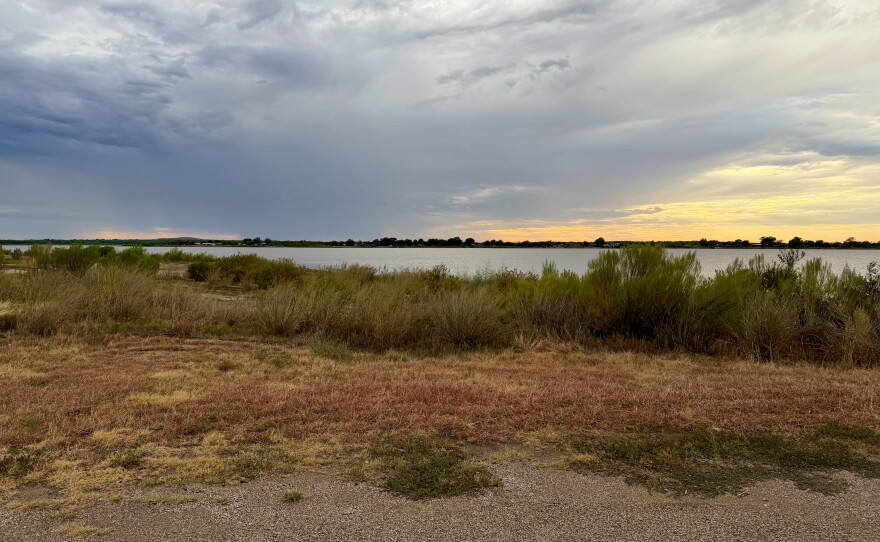

It started at the lake just north of Abilene last summer. Two kids were swimming off a private dock when one of them scraped a foot on a rock. A parent picked the rock up and found a zebra mussel stuck to the bottom of it — the first one anybody had found at Fort Phantom. Michael Homer is a biologist with Texas Parks and Wildlife.
"So TPWD received a phone call from a concerned citizen because two children were swimming at a private residence on the reservoir, and one of them had scraped their foot on something and lifted a rock," Homer said. "And one of the parents noticed that it was a zebra mussel."
Zebra mussels come from Eastern Europe. They got to America in the 1980s through the Great Lakes, dumped out with the water ocean ships carry in their hulls to stay steady, and they've been working their way south and west ever since. Forty Texas lakes have them now. Thirty-six are fully infested.

Spencer Dorsey is a fisheries biologist with Parks and Wildlife here in Abilene. He said crews pulled water samples from six spots around the lake this spring and found larvae at every one of them. So they went looking for the adults. Those are harder to come by.
"Once you're at the right depth, you can find more, but they're all in about that two to four foot of water right now," Dorsey said. "And if you flip rocks, you can find some, but it's going to take some time. They're anywhere from half a pinky nail size up to about an inch long. I think that day we put in about eight hours of search, and we found six of them."
Six mussels, in eight hours. And one adult can put out as many as a million larvae, which are too small to see.
It's not just a fishing problem. Fort Phantom supplies anywhere from a quarter to two-thirds of Abilene's drinking water, depending on the season. Matthew Dane is the director of water utilities for the City of Abilene. He said the mussels aren't really the issue. What they do to the equipment that moves the water is.
"They can tend to build up in some of the infrastructure that's used," Dane said. "So at the end of the day, it's really about that associated with zebra mussels getting up in pump facilities, our intake pipes, surrounding valves, and what kind of maintenance and inspection has to be done to keep an eye on that and try to prevent any sort of service outage or inability to move that water to the water plants."
Dane said the city hasn't found any in its infrastructure yet, but crews are keeping a closer eye on it now. They've dropped test plates into the lake near the intake and pull them up every month to see if anything has attached. If mussels do show up, the fixes get expensive — replacing valves, taking piping apart, cleaning it out. Dane said that cost eventually lands on customers, though he said it may never add up to much.
The water itself is fine.
"There's no reason to be worried in terms of safety and health as far as drinking water that has zebra mussel population in it," Dane said. "If it becomes big enough, it can change some of the chemistry in the water and things, but not in any ways that is a negative impact."
There's also no getting them out of the lake. Dorsey said once they're established, that's it — all anybody can do is keep them from reaching the next one. Which mostly comes down to boats.
"So we're really adamant about clean, drain, dry," Dorsey said. "So what anglers want to do when they're coming off of a water body, especially those infested with any kind of invasive species, is they want to clean their boat. So you're going to clean your boat, your trailer, your gear, and you want to remove all the plants and mud or anything that could be on your boat trailer as you're pulling out. Second, you want to drain the boat. So that's all the water. You want to lower your motor, let all the water run out there, clear your bilge, pull the live well plugs, ballast tanks if you got them, even bait buckets that you might have been holding bait fish in. And then finally you want to dry it. So you want to dry your boat, your compartments, your gear, and we recommend at least one week before launching it onto a new water body."

Dorsey said Hubbard Creek, Stamford and Cisco are all at risk, since they get a lot of the same boats that fish Fort Phantom. Dane said that's the part worth hanging onto.
"Once it gets here, there's really not a whole lot to do. It just becomes a reality we have to live with, and that is really what comes back to the importance of the signs you see around bodies of water throughout the state," Dane said. "When you see the warnings about rinsing boats and watercraft that come out of certain bodies of water, it's really critical to do those kinds of things just to help our neighbors who may not have to deal with that issue. So it takes kind of a collective effort to manage these invasive species, and the better we do, the better off our neighbors are."
The mussels are in 40 Texas lakes now. What's left is keeping them out of the rest.